
 📖Chuyên sâu
How to Use Redux and React
What a store actually is, what Redux Toolkit actually saves you (one line — measured), and what it costs: 10.7 KB gzipped and 0.3 µs per dispatch. With the selector trap that re-renders on every dispatch in your app, and the 147-byte action log that reproduces a bug exactly.
CuongThai
30 tháng 7, 2026 · 26 phút đọc · 1192 lượt xem
Redux has an image problem. It was the default answer for two years, then the punchline for five, and most of what people know about it describes a version that stopped being current in 2019. Meanwhile the actual question — when does an application need a store outside the component tree, and what does that cost — has a measurable answer.
So this guide measures it. Every state transition, render count, selector call and byte below came out of a real store: reducers dispatched in Node, components mounted with jsdom, render counts taken from a counter inside each component body.
@reduxjs/toolkit 2.12.0 · react-redux 9.3.0 · redux 5.0.1 · react 19.2.8
Five of those measurements contradicted something I was about to write, and one of them contradicts the sentence Redux Toolkit is usually sold with.
What Redux actually is, in one reducer
Strip away every library and Redux is one function signature:
(state, action) => newState
That's it. Here it is with no dependency at all:
const initial = { count: 0, user: { name: 'mai' }, items: ['a'] };

function reducer(state = initial, action) {
  switch (action.type) {
    case 'count/inc':
      return { ...state, count: state.count + 1 };
    default:
      return state;
  }
}
const store = createStore(reducer);
const before = store.getState();
store.dispatch({ type: 'count/inc' });
const after = store.getState();
before : {"count":0,"user":{"name":"mai"},"items":["a"]}
after  : {"count":1,"user":{"name":"mai"},"items":["a"]}
Now the part that matters, and that you can only see by comparing references:
Object.is(before, after)             = false
Object.is(before.user, after.user)   = true
Object.is(before.items, after.items) = true
The root object is new, so anything watching the store can tell something changed with one comparison. But user and items are the same objects — the spread copied their references, not their contents. That's structural sharing, and it's the whole performance story of immutable state: a component that only reads state.user can skip re-rendering after a comparison that costs nothing.
And an action nobody handles changes nothing at all:
store.dispatch({ type: 'nothing/at/all' });
same reference as before? true
Which is why default: return state is not boilerplate — it's the contract that makes reference comparison a valid way to detect change.
The store is three functions
store.getState();          // read
store.dispatch(action);    // write
store.subscribe(listener); // be told
subscribe behaves more bluntly than people expect. Measured:
1 dispatch that changes state → listener ran 1 time
1 dispatch that changes NOTHING → listener ran 1 time
3 dispatches in a row          → listener ran 3 times
The store notifies on every dispatch, whether or not the state changed, and it does not batch. All the cleverness about "did this actually change" and "should this component re-render" lives above the store, in useSelector. Keep that division in mind — it explains a measurement later that surprises people.
createSlice, and what it actually saves
The pitch for Redux Toolkit is that it removes boilerplate. I wanted a number, so I wrote the same two-action feature both ways and counted.
Classic Redux:
const ADD = 'todos/add';
const TOGGLE = 'todos/toggle';
export const add = (text) => ({ type: ADD, payload: text });
export const toggle = (id) => ({ type: TOGGLE, payload: id });

export default function todos(state = [], action) {
  switch (action.type) {
    case ADD:
      return [...state, { id: state.length + 1,
                          text: action.payload, done: false }];
    case TOGGLE:
      return state.map((t) =>
        t.id === action.payload ? { ...t, done: !t.done } : t);
    default:
      return state;
  }
}
Redux Toolkit:
const slice = createSlice({
  name: 'todos',
  initialState: [],
  reducers: {
    add(state, a) {
      state.push({ id: state.length + 1, text: a.payload, done: false });
    },
    toggle(state, a) {
      const t = state.find((x) => x.id === a.payload);
      if (t) t.done = !t.done;
    },
  },
});

export const { add, toggle } = slice.actions;
export default slice.reducer;
classic Redux : 14 lines, 500 characters
createSlice   : 13 lines, 370 characters
One line. I expected a rout and got a rounding error — 26% fewer characters and a single line saved. If your reason for adopting Redux Toolkit is line count, the measurement does not support you.
What the measurement misses is where the actual value is, and it's worth being precise about because these are the things that break in hand-written Redux:
- No action-type constants to keep in sync.
slice.actions.addand the reducer that handles it cannot drift apart, because they're generated from the same key. Every codebase with hand-written types has at least one action that's dispatched and never handled. - No manual immutable updates. The
state.map(t => t.id === id ? {...t, done: !t.done} : t)line above is correct; the one someone writes at 6pm won't be. More on that next. - The defaults are configured. Thunks, DevTools, and two development-time guards, without a store setup file.
createSlicegives you one place per feature. That's a structural benefit, and it's the same argument as feature folders in the React structure guide.
So the honest pitch is "fewer ways to be wrong", not "less code".
immer: mutations that aren't
Inside a createSlice reducer you write what looks like mutation:
addQty(state, action) {
  state.items[0].qty += action.payload;
}
Nothing is mutated. Immer hands your reducer a draft — a Proxy that records writes — then produces a new state from the recording. Measured on a cart with items, coupon and meta:
before.items[0] : {"id":1,"qty":1}
after.items[0]  : {"id":1,"qty":3}

Object.is(before, after)             = false
Object.is(before.items, after.items) = false
Object.is(before.meta, after.meta)   = true   ← untouched, same reference
before.items[0].qty is still 1
Read the third line. meta was not part of the update, so immer reused the exact same object — the same structural sharing as the hand-written spread, produced automatically along the path you actually touched. And the old state is genuinely unchanged: before.items[0].qty is still 1 after the dispatch.
A reducer that touches nothing returns the same state object:
reducer that changes nothing → same reference? true
Two things to know about immer in practice. You may either mutate the draft or return a new value, never both in one reducer — returning a value while also having written to the draft is an error. And the draft is only a draft during the reducer: don't hold onto it, don't pass it to an async callback, and don't return it from a selector.
The two guards you get for free
configureStore turns on development-time checks that catch the two classic Redux bugs. I tried to trigger both.
Mutating state outside a reducer:
store.getState().bad.n = 99;
TypeError: Cannot assign to read only property 'n' of object '#<Object>'
Here's a detail I had wrong. I was going to describe this as the immutability middleware catching the mutation on the next dispatch. It's better than that: RTK freezes state with immer, so the assignment throws immediately, at the line that did it, before any dispatch happens. You get a stack trace pointing at the culprit instead of a warning pointing at the next unrelated action.
A non-serializable payload:
store.dispatch({ type: 'bad/withDate',
                 payload: { when: new Date(0), fn: () => {} } });
A non-serializable value was detected in an action,
in the path: `payload.when`.
It names the exact path. This check exists because two Redux features depend on state and actions being plain data: time-travel debugging, and serialising state to storage or to a server. A Date in an action works fine until someone tries to replay it.
Both checks are development-only and cost nothing in production. If a specific action genuinely needs a non-serializable payload, configure the exception rather than disabling the check:
configureStore({
  reducer,
  middleware: (gdm) => gdm({
    serializableCheck: { ignoredActions: ['upload/setFile'] },
  }),
});
useSelector subscribes at the leaf
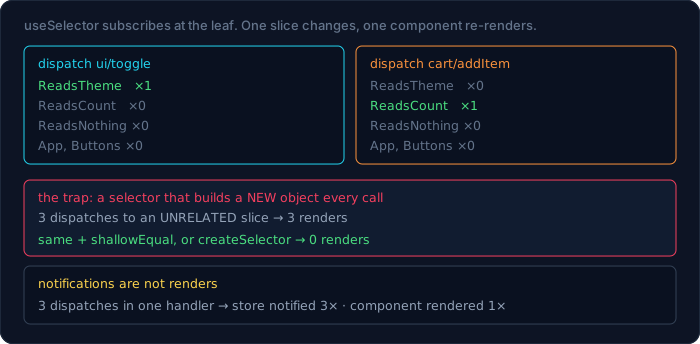
This is the measurement that decides whether Redux helps or hurts a React app. A store with two slices, and four components: one reads the theme, one reads the cart count, one reads nothing, one only dispatches.
const ReadsTheme = () => <span>{useSelector(s => s.ui.theme)}</span>;
const ReadsCount = () => <span>{useSelector(s => s.cart.items.length)}</span>;
dispatch ui/toggle     → {ReadsTheme: 1}
dispatch cart/addItem  → {ReadsCount: 1}
One component per dispatch. App didn't re-render. Buttons didn't. ReadsNothing didn't. The component that read the changed slice did, and nothing else.
That is a genuinely different shape from context, and it's the honest technical case for a store. The React structure guide measured the same tree six ways; this fits on the end of that table:
| Approach | Components re-rendered |
|---|---|
| state at the top, props down | 5 |
| one context holding two values | 3 |
| two contexts, split by rate of change | 2 |
| state at the leaf that needs it | 1 |
Redux + useSelector |
1 |
useSelector is built on useSyncExternalStore, the same primitive as a hand-rolled store — so the render behaviour is identical, and what Redux adds on top is the reducer discipline, the DevTools, and the middleware layer. If all you wanted was leaf subscriptions, you don't need Redux for that.
The selector trap that costs you every dispatch
useSelector re-renders when its result changes by reference. So a selector that builds a new object every call changes every time, and the component re-renders on every dispatch in the application — including dispatches to slices it doesn't read.
// re-renders on every dispatch, anywhere
const t = useSelector((s) => ({
  count: s.cart.items.length,
  sum: s.cart.items.reduce((a, i) => a + i.price, 0),
}));
Three dispatches to an unrelated slice (ui/toggle), with the cart untouched:
new object each call → Totals rendered 3 times
useSelector(..., shallowEqual) → Totals rendered 0 times
useSelector(createSelector(...)) → Totals rendered 0 times
Zero versus three, on dispatches that had nothing to do with this component's data. And react-redux will tell you, in development, in as many words:
Selector unknown returned a different result when called with the same
parameters. This can lead to unnecessary rerenders.
Selectors that return a new reference (such as an object or an array)
should be memoized
Two fixes, and they're not equivalent:
// 1. compare the result shallowly instead of by reference
useSelector(selectTotals, shallowEqual);

// 2. memoise the selector so the reference is stable
const selectTotals = createSelector(
  [(s) => s.cart.items],
  (items) => ({ count: items.length,
                sum: items.reduce((a, i) => a + i.price, 0) }),
);
shallowEqual stops the re-render but still runs your computation on every dispatch. createSelector stops both. If the computation is a .length, use shallowEqual and move on; if it's a reduce over a thousand rows, memoise.
The cheapest fix of all is to not build an object:
const count = useSelector((s) => s.cart.items.length);
const sum = useSelector((s) => s.cart.total);
Two useSelector calls returning primitives need no memoisation at all, because numbers compare by value. Reach for createSelector when you're deriving something, not when you're reading two fields.
createSelector, measured
createSelector memoises on its inputs. What that means precisely:
const memoed = createSelector(
  [(s) => s.cart.items],
  (items) => items.reduce((a, i) => a + i.price, 0),
);
called 5 times, state unchanged
  plain function  → computed 5 times
  createSelector  → computed 1 time

3 dispatches to a DIFFERENT slice, then called again
  createSelector  → computed 0 times

3 dispatches that CHANGE cart, then called again
  createSelector  → computed 3 times
The middle result is the useful one: dispatching to ui produced a new root state object, and createSelector still didn't recompute, because its input — state.cart.items — was the same reference. That's structural sharing paying off twice: once to skip a render, once to skip a computation.
Two caveats that catch people. A createSelector has a cache size of one by default, so a selector shared by many components with different arguments thrashes:
// one cache slot, shared by every row → recomputes constantly
const selectById = createSelector(
  [(s) => s.posts.entities, (s, id) => id],
  (entities, id) => entities[id],
);
The fix is a selector factory per component instance, or createSelector with a larger cache (RTK 2 uses weakMapMemoize by default for exactly this reason, which handles the common case). And an input selector that itself builds a new object defeats the whole thing — inputs must be stable references, which in practice means they should be plain field reads.
Async: one call, three actions
createAsyncThunk turns a promise into a small state machine. One thunk produces three action types, and you handle the ones you care about:
const fetchUser = createAsyncThunk('users/fetch', async (id) => {
  if (id === 'boom') throw new Error('server said no');
  return { id, name: `user-${id}` };
});
extraReducers: (b) => {
  b.addCase(fetchUser.pending,   (s) => { s.status = 'loading'; s.error = null; })
   .addCase(fetchUser.fulfilled, (s, a) => {
     s.status = 'ok';
     s.data = a.payload;
   })
   .addCase(fetchUser.rejected, (s, a) => {
     s.status = 'failed';
     s.error = a.error.message;
   });
}
With a middleware spying on every action that reached the store:
success → ["users/fetch/pending", "users/fetch/fulfilled"]
          state {"status":"ok","data":{"id":"7","name":"user-7"},"error":null}

failure → ["users/fetch/pending", "users/fetch/rejected"]
          state {"status":"failed","data":{"id":"7",…},"error":"server said no"}
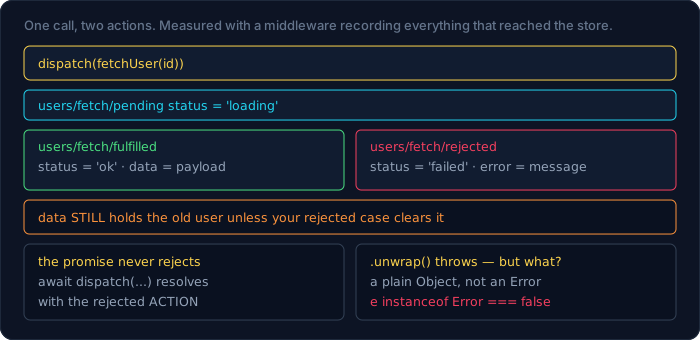
Look at the failure state carefully: status is failed and data still holds the previous user. That's not a bug in RTK, it's a decision my reducer made by not clearing data in the rejected case. Whether that's right depends on the screen — keeping stale data while showing an error banner is often better than blanking the page — but it should be a decision, not an accident. Write the rejected case explicitly every time.
Two behaviours of the returned promise that trip people up:
dispatch(...) resolved with type=users/fetch/rejected · has .error? true
dispatch(thunk()) does not reject. It resolves with the rejected action, so try/catch around a dispatch catches nothing. To get a throw, ask for one:
try {
  await store.dispatch(fetchUser('boom')).unwrap();
} catch (e) {
  // handle it
}
.unwrap() → throws Object: server said no
And note what it throws: an Object, not an Error. RTK serialises the error into a plain object ({ name, message, stack, code }) because actions must be serialisable, so e instanceof Error is false in a .unwrap() catch block. Check e.message, not the constructor. That one cost me a minute of disbelief.
condition: deduplication in one line
Three components mount at once and each asks for the same data. The classic fix is a flag in the component; the built-in fix is an option on the thunk:
const load = createAsyncThunk(
  'feed/load',
  async () => { /* fetch */ },
  { condition: (_arg, { getState }) => getState().feed.status !== 'loading' },
);
await Promise.all([store.dispatch(load()),
                   store.dispatch(load()),
                   store.dispatch(load())]);
the fetch function ran 1 time
blocked by condition: 2 of 3 (meta.condition === true)
Three dispatches, one request. The blocked dispatches resolve immediately with meta.condition: true and never emit pending or fulfilled, so your reducers don't see them at all. This is the entire feature that request-deduplication libraries are famous for, available as a three-line option — worth knowing before you add a dependency for it.
RTK Query: the part that replaces your thunks
If the state you're storing came from a server, createAsyncThunk is the wrong tool and RTK ships the right one in the same package. Three components asking for the same data:
const api = createApi({
  reducerPath: 'api',
  tagTypes: ['Post'],
  endpoints: (b) => ({
    getPosts: b.query({ queryFn: fetchPosts, providesTags: ['Post'] }),
    addPost: b.mutation({ queryFn: postIt, invalidatesTags: ['Post'] }),
  }),
});
const Row = ({ tag }) => {
  const { data, isLoading } = api.endpoints.getPosts.useQuery();
  return <span>{isLoading ? '…' : `${tag}:${data.length}`}</span>;
};
3 components calling useQuery('getPosts') → the fetch function ran 1 time
DOM "a:1b:1c:1"
mounting a 4th component later            → 0 additional fetches (cache)
dispatching a mutation with invalidatesTags → 1 refetch, automatically
cache keys: ["getPosts(undefined)"]
Four behaviours, none of which you wrote: request deduplication across components, a cache keyed by endpoint + arguments, automatic refetch of exactly the queries a mutation invalidates, and isLoading/isError/data without a reducer case each. Compare that with the condition option earlier — that gave you deduplication for one thunk; this gives you the whole cache.
The tag system is the part worth understanding, because it's the whole invalidation model in two words:
getPosts:  b.query({ providesTags: ['Post'] })
getPost:   b.query({ providesTags: (r, e, id) => [{ type: 'Post', id }] })
addPost:   b.mutation({ invalidatesTags: ['Post'] })
editPost:  b.mutation({ invalidatesTags: (r, e, a) =>
             [{ type: 'Post', id: a.id }] })
A mutation says what it invalidated; every query that provides a matching tag refetches. Nothing subscribes to anything by hand. Editing one post refetches that post and any list that provides the general Post tag, and nothing else.
Which sharpens the honest recommendation: if you're reaching for Redux because of server data, use RTK Query and write almost no reducers. If you're not otherwise using Redux, TanStack Query does the same job without the store. Either way, hand-written thunks for CRUD are the option that costs the most and gives the least.
Listener middleware: takeLatest without a saga
Redux Saga existed because reducers can't do effects and thunks can't be cancelled. RTK's listener middleware covers most of what people used sagas for, and cancellation is the interesting part. A debounced search where every keystroke dispatches:
listener.startListening({
  actionCreator: typed,
  effect: async (action, api) => {
    api.cancelActiveListeners();   // ← makes this takeLatest
    await api.delay(20);           // ← debounce
    runs.push(action.payload);
  },
});
Four keystrokes in a row — r, re, red, redu:
effect ran to completion 1 time: ["redu"]
Three effects were cancelled mid-delay and only the last one finished. That's takeLatest plus debounce in two lines, with no generators and no extra dependency. The same API gives you condition (wait for a future action), take, fork/unsubscribe, and access to getState/dispatch.
Where it belongs: reacting to actions with side effects that aren't a data fetch — analytics, a toast, syncing to localStorage, starting a websocket, invalidating something. Where it doesn't: business logic that should be a reducer, or a fetch that should be RTK Query.
configureStore({
  reducer,
  // prepend, so the listener sees actions before the dev checks
  middleware: (gdm) => gdm().prepend(listener.middleware),
});
Time travel is just replaying the log
"Time-travel debugging" sounds like magic and is arithmetic. Because every action is plain serialisable data and every reducer is pure, the state is a function of the action list — so recording the list is recording the session. A middleware that pushes each action into an array:
const recorder = () => (next) => (action) => {
  log.push(action);
  return next(action);
};
Four dispatches, then send the log through JSON — exactly as it would travel attached to a bug report — and replay it into a fresh store:
const wire = JSON.stringify(log);
const s2 = makeStore();
JSON.parse(wire).forEach((a) => s2.dispatch(a));
recorded 4 actions · the log as JSON = 147 bytes

original state : {"items":[{"id":1}],"coupon":"TET25"}
replayed state : {"items":[{"id":1}],"coupon":"TET25"}
identical? true
147 bytes reproduced the exact state. And stopping early is stepping backwards in time:
JSON.parse(wire).slice(0, 3).forEach((a) => s3.dispatch(a));
replaying 3 of 4 actions: {"items":[{"id":1},{"id":2}],"coupon":"TET25"}
That's the whole feature, and it's why the serializability check earlier is not pedantry: a Date or a File in an action breaks the JSON round trip, and with it the ability to replay. It's also the most under-used debugging technique in front-end work — "attach your action log" turns an unreproducible report into a test case.
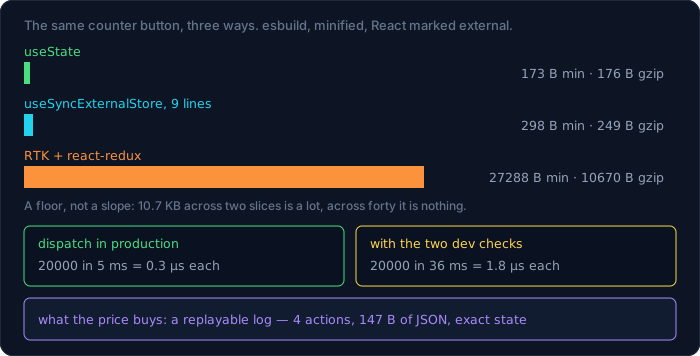
This is the capability no useState refactor gives you, and the honest reason to keep Redux in an application complex enough to have unreproducible bugs.
DevTools: what the log buys you in practice
configureStore wires up the Redux DevTools extension with no configuration, and the replay measurement above is exactly what powers it. Four things it gives you that a console.log doesn't:
- The action list — every dispatch, in order, with its payload. When a user says "it broke after I hit save twice", the list shows whether the second save dispatched at all.
- A state diff per action. Not the whole state — the fields that changed. This is the fastest way to find a reducer that changes more than it should, which in immer-based code usually means a stray write to a draft.
- Jump and skip. Click an earlier action and the app renders that state; toggle one action off and everything after it recomputes without it. That's the replay above, driven from a UI.
- Export and import. The action log as a JSON file — 147 bytes in the measurement earlier — attachable to a bug report and replayable on your machine.
Two practical notes. Trim it in production rather than shipping the whole history:
configureStore({
  reducer,
  devTools: process.env.NODE_ENV !== 'production',
});
And if the DevTools panel says "no store found", the usual cause is two stores (one created at module scope, one in a test or in a hot-reloaded module) rather than a wiring problem.
The reason to mention this in a structure guide is that these features are the entire return on Redux's constraints. Serialisable actions, pure reducers, one write path — each of those is a rule you follow at every keystroke, and the log is what you get for following them. If a project doesn't use the log to debug, it's paying the rules and collecting nothing, which is a fair sign the state belongs somewhere simpler.
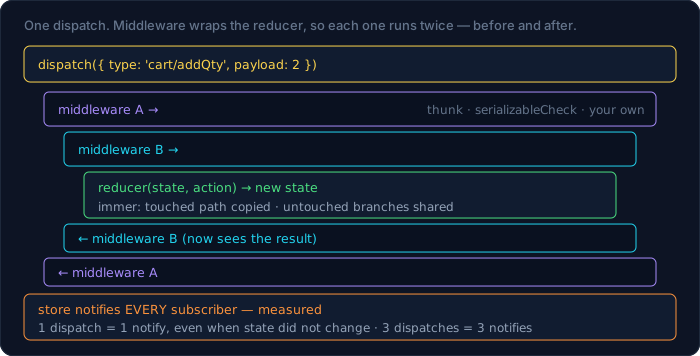
Middleware is an onion
Every middleware wraps the next one, and the reducer is in the middle. Two loggers that record before and after:
const mk = (name) => () => (next) => (action) => {
  order.push(`${name} →`);
  const r = next(action);
  order.push(`← ${name}`);
  return r;
};
A → B → ← B ← A
So A sees the action before B does, and sees the world after the reducer has run when next returns. That ordering is why the position of concat matters:
configureStore({
  reducer,
  middleware: (gdm) => gdm().concat(logger, analytics),
});
gdm() is getDefaultMiddleware — the thunk middleware plus the two dev checks. Always build on it rather than replacing it, or you lose thunks silently. Use prepend when your middleware must see actions before the defaults do (for example, to rewrite an action before the serializability check inspects it).
The onion shape is also what makes middleware the right place for cross-cutting concerns — analytics, optimistic updates, retry, offline queueing — and the wrong place for business logic, which belongs in reducers where it's testable as a pure function.
One action, several slices
This is the structural capability that no per-component state can reproduce, and it's three lines. A logout should clear the cart, the draft nobody submitted, and the auth user — in a component-state world that's a chain of callbacks or an effect that knows about everything.
const loggedOut = createAction('auth/loggedOut');

// each slice cleans up its own corner, in its own file
const auth = createSlice({ name: 'auth', initialState: { user: 'mai' },
  reducers: {},
  extraReducers: (b) => { b.addCase(loggedOut, (s) => { s.user = null; }); },
});

const cart = createSlice({ name: 'cart', initialState: { items: [1, 2, 3] },
  reducers: {},
  extraReducers: (b) => { b.addCase(loggedOut, (s) => { s.items = []; }); },
});
before: {"auth":{"user":"mai"},"cart":{"items":[1,2,3]},
         "draft":{"text":"xin chao"}}
after : {"auth":{"user":null},"cart":{"items":[]},
         "draft":{"text":"xin chao"}}

slice that ignored the action → same reference? true
One dispatch, two slices updated, and draft — which doesn't listen — kept its exact object, so anything reading it doesn't re-render. Neither slice imports the other; they both import the action. That's the inversion that makes this scale: features subscribe to events rather than calling each other, which is the same rule as "features don't import features" from the React structure guide, enforced by the architecture instead of by a lint rule.
addMatcher generalises it when you want a whole family:
extraReducers: (b) => {
  b.addMatcher(
    (a) => a.type.endsWith('/rejected'),
    (s, a) => { s.lastError = a.error?.message ?? 'unknown'; },
  );
}
One case that catches every rejected thunk in the application — a global error slice in five lines.
Testing: the payoff for keeping reducers pure
A reducer is (state, action) => state. That means testing one needs no store, no Provider, no mocks, no async. Called directly:
let s = reducer(undefined, { type: '@@INIT' });
s = reducer(s, add('mua sua'));
const snapshot = s;
s = reducer(s, toggle(1));
✓ initial state is []
✓ add appends one item
✓ toggle flips done
✓ the previous state was NOT mutated
✓ an unknown action returns the SAME reference
5/5 pass · 0 mocks · 0 store
The fourth and fifth assertions are the ones worth copying, because they test the two properties the rest of the system relies on. If a reducer mutates its input, structural sharing breaks and components stop re-rendering sometimes. If an unknown action returns a new object, every component re-renders on every unrelated dispatch. Both are silent, and both are one line to catch.
For selectors, the same: they're pure functions of state, so a test passes a literal state object and asserts on the output — no store needed there either. Test the components with a real store and no mocks (configureStore in the test, wrap in Provider), and keep mocks for the network boundary only.
The createSelector cache, and an old warning that's now obsolete
Plenty of articles warn that a selector taking an argument is dangerous, because createSelector has a cache of one and components with different arguments will thrash it. I was going to repeat it. Measured on RTK 2:
const selectById = createSelector(
  [(s) => s.posts.entities, (s, id) => id],
  (entities, id) => entities[id],
);

for (const id of ['a', 'b', 'c', 'a', 'b', 'c']) selectById(state, id);
RTK 2 default (weakMapMemoize)        → computed 3 times
same selector with lruMemoize (size 1) → computed 6 times
Six calls across three ids: three computations with the default, six with the old memoiser. RTK 2 changed the default to weakMapMemoize, which caches per argument set rather than only the most recent one — so the classic thrash is gone unless you've explicitly configured lruMemoize or you're on RTK 1.
Which makes the current advice much simpler than the old advice: write selectors that take arguments, keep input selectors as plain field reads, and only think about memoisation strategy if you measure a problem. If you're on an older version, the workaround was a selector factory per component (useMemo(() => makeSelectById(), [])) — and it's worth checking your version before you write that.
Normalised state with createEntityAdapter
Storing a list as an array means every lookup is a scan and every update rewrites the array. createEntityAdapter keeps ids and entities separately and gives you the reducers:
const adapter = createEntityAdapter();

const slice = createSlice({
  name: 'posts',
  initialState: adapter.getInitialState({ loading: false }),
  reducers: {
    setAll: adapter.setAll,
    upsert: adapter.upsertOne,
    remove: adapter.removeOne,
  },
});
after setAll : {"ids":["a","b"],
                "entities":{"a":{"id":"a","t":"A"},"b":{"id":"b","t":"B"}},
                "loading":false}

after upsert b : ids=["a","b"]  b.t=B2
Object.is(entities.a before, after) = true   ← untouched record kept
selectAll().length = 2 · selectById('b').t = B2
The last two lines are the payoff. Updating b left a's object identical by reference, so a memoised row component for a skips its re-render — the array version would have produced a new array and, depending on how you wrote the update, new objects for every row. And ids keeps order separately from the lookup table, so sorting doesn't touch the data.
Use it whenever the same records are referenced from more than one place. Skip it for a list you fetch, render once, and throw away.
Store notifications are not renders
Here's the measurement that ties the store and React halves together. A handler dispatching three times, a component reading three fields with three separate useSelector calls:
onClick={() => { d(incA()); d(incB()); d(incC()); }}
store.subscribe ran   3 times   (redux notifies per dispatch)
Reader rendered       1 time    (React batches)
DOM "111"
Three notifications, one render. useSelector is built on useSyncExternalStore, and React batches the resulting updates within the event — so the store's lack of batching does not become a rendering problem. Three useSelector calls in one component also produce one render, not three.
Which means "I should combine my dispatches to reduce renders" is optimising something that isn't happening. There is a real cost to many dispatches — each one runs every reducer and notifies every subscriber — but it's not measured in React renders.
What Redux costs
The honest number, because the "when not to use it" section needs one. The same counter button, built three ways, bundled and minified with esbuild, with React marked external (as it would be in a real app):
                       minified    gzip    brotli
useState                   173 B    176 B     124 B
useSyncExternalStore       298 B    249 B     192 B
RTK + react-redux       27,288 B  10,670 B   9,741 B
About 10.7 KB gzipped for a counter. That's the floor: configureStore pulls in immer, reselect and redux whether you use them or not. It doesn't grow much as your app does, which is the point of a floor — 10.7 KB across two slices is a lot, and across forty is nothing.
(The first row is a fun artefact: gzip made the 173-byte file bigger, 176 bytes, because the gzip header costs more than the compression saves on tiny inputs. If you ever see a build report claiming a file grew when compressed, that's why.)
The runtime cost is the other half, and it's smaller than the bundle discussion suggests. 20,000 dispatches through a one-line reducer:
default middleware (both dev checks on)  → 36 ms = 1.8 µs per dispatch
dev checks disabled                      →  5 ms = 0.3 µs per dispatch
0.3 microseconds per dispatch in production, because both guards are development-only. So the 6× difference you can measure locally is not something your users pay — but it is worth knowing if a development session feels sluggish while a list dispatches per row. The fix there is to narrow the checks rather than remove them:
middleware: (gdm) => gdm({
  immutableCheck: { ignoredPaths: ['bigTable'] },
  serializableCheck: { ignoredPaths: ['bigTable'] },
}),
At 0.3 µs, dispatch is never your bottleneck. Selectors that recompute and components that re-render are — which is what the first half of this guide measured.
When you don't need Redux
Most apps. Said plainly, because the measurements above make the case better than an opinion would.
If your state is server data, you want a query library, not a store. Fetching, caching, revalidation, dedup and loading states are what TanStack Query, SWR, or your framework's loaders do. Putting server data in Redux means hand-writing a cache — and the condition measurement above is the only part of that job Redux hands you for free. If you already have RTK, use RTK Query rather than writing thunks per endpoint.
If your state is local, keep it local. The React structure guide measured this: state pushed down to the component that needs it re-renders 1 component instead of 5. A store cannot beat that, and it adds a file.
If you need shared state and nothing else, a nine-line store is 249 bytes gzipped. useSyncExternalStore gives leaf subscriptions with no library, and Zustand gives the same with a nicer API for about 1 KB. You lose DevTools, time travel and middleware — decide whether you want them before paying 10.7 KB for them.
Redux earns its place when you want the things only a reducer log gives you: a serialisable history of every state transition, time-travel debugging, replaying a user's session from a bug report, middleware that can see every change in the app, and one file per feature that describes every way its state can change. Those are real, and no useState refactor gives them to you.
And this site doesn't use it. The frontend is Next.js with the app router; server state lives in server components and route handlers, and client state is local or in a small number of contexts. For ~40 modules that was the right call, and the same reasoning appears in the GraphQL and webpack guides: the interesting question is never "is this tool good", it's "does this application have the problem the tool solves".
Typing it, in four lines
Redux with TypeScript has a reputation for ceremony that Redux Toolkit mostly removed. The whole setup is two types inferred from the store and two pre-typed hooks:
// app/store.ts
export const store = configureStore({
  reducer: { cart: cartReducer, auth: authReducer },
});

export type RootState = ReturnType<typeof store.getState>;
export type AppDispatch = typeof store.dispatch;
// app/hooks.ts
export const useAppDispatch = useDispatch.withTypes<AppDispatch>();
export const useAppSelector = useSelector.withTypes<RootState>();
Then every component uses the typed hooks and gets full inference with no annotations:
const items = useAppSelector((s) => s.cart.items);   // inferred
const dispatch = useAppDispatch();                   // knows about thunks
Three things this buys that are easy to miss. RootState is derived from the store rather than hand-written, so adding a slice updates every selector's type automatically — a hand-maintained RootState interface is a file that silently goes stale. AppDispatch is what makes dispatch(someThunk()) type-check and return a promise with .unwrap(); the untyped useDispatch doesn't know thunks exist. And createSlice infers the action payload type from the reducer's PayloadAction<T>, so the action creators are typed without a separate declaration:
reducers: {
  setCoupon(state, action: PayloadAction<string | null>) {
    state.coupon = action.payload;
  },
}
For selectors defined outside a component, type the state parameter and everything downstream follows:
export const selectTotal = (s: RootState) =>
  s.cart.items.reduce((a, i) => a + i.price, 0);
If a codebase has any in its selectors, that's usually a missing withTypes rather than a hard typing problem.
A structure worth keeping
If you do use it, this is the layout that stays workable:
src/
  app/
    store.ts            configureStore, one file, no logic
  features/
    cart/
      cartSlice.ts      slice + selectors + thunks for THIS feature
      cartSelectors.ts  createSelector, when there are enough to move out
      CartPage.tsx
    auth/
      authSlice.ts
- One slice per feature, next to the components that use it. Not a
reducers/directory — same argument as feature folders generally. - Selectors live with the slice, and components import selectors rather than reaching into state shape. Then a state reshape touches one file.
store.tsonly composes. If it has anifin it, something belongs in a slice.- Never import a slice from another feature's slice. Cross-feature reactions belong in a listener middleware or a shared slice.
- Thunks handle orchestration, reducers handle state. A reducer that calls anything asynchronous is a bug the dev-time guards won't catch.
What I got wrong measuring this
Five, and the first is the one worth carrying away.
"Redux Toolkit removes a lot of boilerplate." Measured on the same two-action feature: 14 lines versus 13, 500 characters versus 370. One line. The real benefits — no action constants to desync, no hand-written immutable updates, dev guards on by default — are about correctness, not volume. I'd have written the volume claim and it would have been wrong.
Mutating state outside a reducer is caught by the immutability middleware. It's caught earlier and better: RTK freezes state, so the assignment throws a
TypeErrorat the exact line, before any dispatch. I was about to describe a warning that arrives one action later..unwrap()throws yourError. It throws a plain serialisedObject—e instanceof Errorisfalse. Checke.message.Three dispatches in one handler means three renders. The store notified 3 times and the component rendered once, because react-redux is built on
useSyncExternalStoreand React batches. Store notifications and renders are different counters, and only one of them is the one you care about."A
createSelectorthat takes an argument thrashes its one-slot cache." True on RTK 1, obsolete on RTK 2: six calls across three ids computed three times with the current defaultweakMapMemoize, and six times only when I explicitly configured the oldlruMemoize. Version-dependent advice again — the same shape as the webpack CSS finding.
The thread connecting them: four of the five are cases where I assumed a mechanism from an outcome I'd read about. The freeze versus middleware, the serialised error versus the thrown one, the notification versus the render — in each case the outcome I expected was roughly right and the mechanism was different, which is exactly the kind of error that survives until something behaves unexpectedly and you have no model to debug it with.
Cheat sheet
// the four things you write
createSlice({ name, initialState, reducers, extraReducers })
createAsyncThunk('feature/verb', async (arg, thunkApi) => …, { condition })
createSelector([inputs], (…values) => derived)
configureStore({ reducer, middleware: (gdm) => gdm().concat(mw) })
| Symptom | Cause |
|---|---|
| component re-renders on every dispatch | selector returns a new object — memoise or read primitives |
createSelector recomputes constantly |
an input selector returns a new reference, or one cache slot is shared |
try/catch around a dispatch catches nothing |
dispatch(thunk()) resolves; use .unwrap() |
e instanceof Error is false in a thunk catch |
RTK serialises errors to plain objects |
TypeError: Cannot assign to read only property |
you mutated state outside a reducer; RTK froze it |
| "non-serializable value detected" | a Date, Map, File or function in an action or state |
| stale data shown next to an error | the rejected case didn't clear it — decide explicitly |
| duplicate requests on mount | add condition to the thunk |
| thunks stopped working after a store change | middleware replaced instead of gdm().concat(...) |
| row components all re-render on one edit | store the list as ids + entities via createEntityAdapter |
Where to go next
- How to Structure and Organize a React Application — the render-scope table this guide extends, plus the state-boundary measurement that decides whether you need a store at all.
- How to Set Up webpack From Scratch — how to check what a dependency really costs your bundle, including why
sideEffects: falsedecides whether unused code disappears. - Code Lab — graded exercises: write the reducer, then fix the selector that re-renders on every dispatch, then delete the store you didn't need.
Bài liên quan
Chuyên sâu
Tôi tự xây một công cụ kiểu Jira: CT Work sau 21 ngày, 113 commit và mười lỗi đã trả giá
Nhật ký kỹ thuật của CT Work, công cụ quản lý dự án và đồ án sinh viên FPT dùng thật: kiến trúc và mã thật, AI agent qua MCP, số đo bằng lệnh (243 model, 68 trang, 1.514 ca test), mười lỗi đã sửa, mẹo dùng — và khi nào không nên dùng.

Chuyên sâu
AI Code: agent lập trình trong app desktop — cách dựng, lỗi đã gặp, và cách dùng cho đáng tiền
Agent lập trình trong app desktop CuongThai: kiến trúc và mã thật, 174 commit trong 48 ngày, 9 lỗi đã gặp và cách sửa, vì sao giá một lượt không nói lên giá trong vòng lặp gọi tool, mẹo chọn model — và khi nào KHÔNG nên dùng.

Chuyên sâu
Mã hoá cho lập trình viên: AES, RSA, chữ ký số — và vì sao đừng bao giờ tự viết thuật toán
Bắt đầu từ một file bài thi .dat mở ra không được: entropy 7,99 nói lên điều gì, vì sao dò khoá AES là bất khả thi về mặt VẬT LÝ chứ không phải "rất khó", AES khác RSA ra sao (đo thật: chênh ~1.520 lần). Kèm thí nghiệm ECB làm lộ nguyên hình ổ khoá và sáu vụ sập kinh điển.

Chuyên sâu
Có bao nhiêu loại cơ sở dữ liệu — và chọn cái nào cho việc gì
"SQL hay NoSQL" là phép chia sai: một vế là ngôn ngữ, vế kia nghĩa đen là "không phải cái kia". Bài này chia lại theo mô hình dữ liệu (11 loại), theo tải công việc và theo cách triển khai; giải thích ACID, mức cô lập, write skew, CAP bị hiểu sai ở đâu, B-tree so với LSM-tree; kèm cây quyết định, mười sai lầm hay gặp, và hồ sơ thật của chính trang này — 248 bảng trên một Postgres, một VPS 6GB.
Bình luận